Kachin human rights activist is awarded Stefanus Prize
“This award allows me to emerge from the shadows,” says human rights advocate Dr. Ja Seng Ing, MD. Thursday, she received the Stefanus Prize for her work to promote freedom of religion or belief in Myanmar.
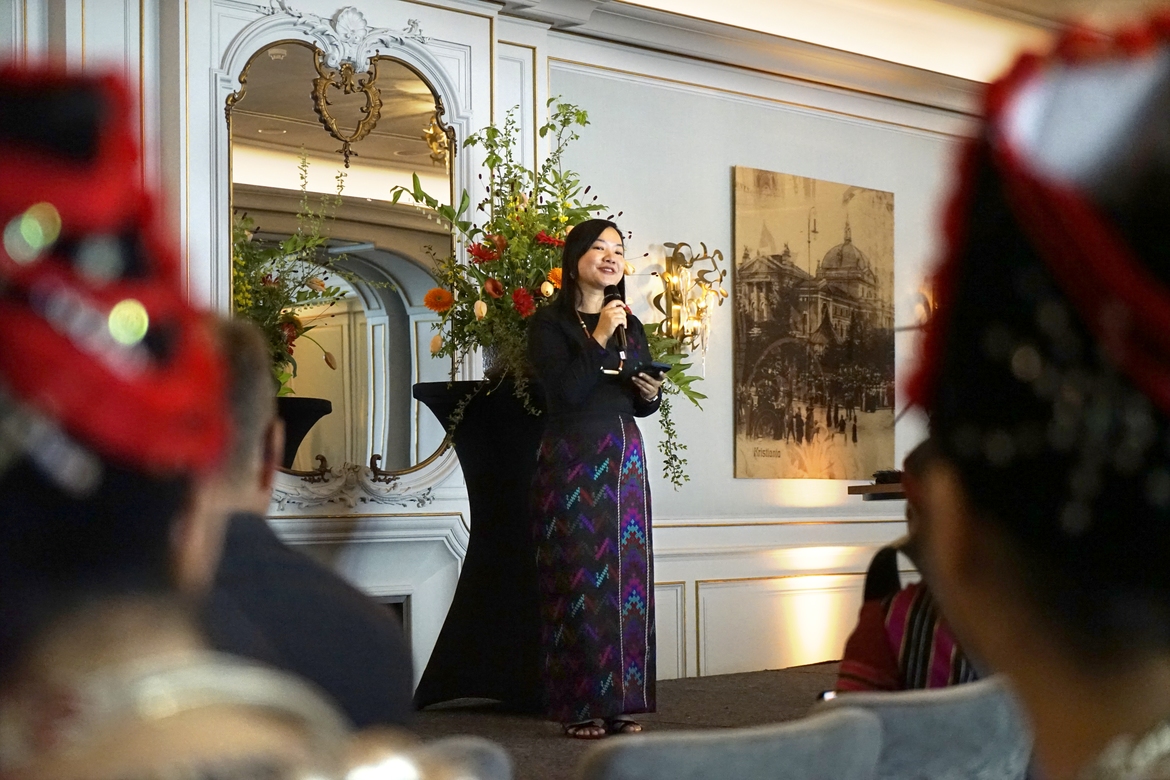
After the military coup in Myanmar, Dr. Ja Seng Ing, M.D. took great risks to stay and document the military's attacks on places of worship and other human rights violations. Thursday May 28 she was awarded the Stefanus Prize for 2026, for her courageous fight for freedom of religion and belief in Myanmar.
As both a physician and a human rights activist, 36-year-old Ja Seng Ing has dedicated her entire adult life to the pursuit of freedom of religion or belief, the protection of human rights, and the defense of religious minorities and women in Myanmar. Her work for democracy has helped create a network of civil society groups who can help sustain a future democratic government.
A forgotten crisis
“Our struggle for freedom in Myanmar has been forgotten by many; others have chosen to ignore it in a world with so many wars, crises, and conflicts. The Stefanus Prize shows us that we are not alone after all. I am deeply grateful to my friends who nominated me and to the Stefanus Alliance’s prize committee,” said Ja Seng Ing in a video interview from New Zealand.
Systematic undercounting
Ja Seng comes from Kachin State in the northeast of Myanmar, on the Chinese border. The Kachin people, to whom she belongs, are one of the many ethnic minorities in the country. While official 2014 census figures suggest Christians make up only 40% of the population in Kachin State, the real numbers are far higher. Ja Seng Ing estimates 95% of the Kachin population are Christian.
By excluding populations from official records, the government weaponizes census data to, among other things, distort resource distribution. This solidifies the dominance of the Bamar majority and legitimize oppression of ethnic and religious minorities.
When Nobel Peace Prize laureate Aung San Suu Kyi was released from military house arrest in 2010, a decade of hope began for the pro-democracy movement. But back home in Kachin State, a 17-year ceasefire between the Kachin Independence Army (KIA) and the military was broken in June 2011 – and conflict resumed. Toward the end of her medical studies in Yangon, Myanmar would see major upheaval, as the nationwide Saffron revolution took place in 2017.
Both in Yangon city and back home in Kachin State, Seng felt the majority population had little understanding of what ethnic and religious minorities had long been subjected to. Myanmar has been scarred by one of the world’s longest ongoing civil wars – spanning six decades at that time. When social media arrived in Myanmar in 2010 and 2011, a new kind of digital warfare emerged. Military lobbyists spread propaganda and lies, dismissing the suffering of minorities even as conflicts intensified, especially in Kachin State.
“It was painful to see social influencers, safe from the conflict, often supporting the military’s negative rhetoric against religious and ethnic minorities and dismissing our suffering,” Seng recalls.
That was one of the mechanisms that kept much of the minorities suffering invisible to people in the cities – in some small ways, even for Ja Seng herself. “In Yangon, I had lived a sheltered life and kept the conflict at home at a distance,” said Ja Seng.
A voice for those with no way to speak
So when she returned home as a doctor in 2012, she immediately jumped in to provide emergency aid and relief for those displaced in Kachin State and Northern Shan State. For two years, Ja Seng worked for the Kachin Baptist Convention, providing aid to those the state had largely ignored.
“I realized that I couldn’t stay silent while others had no way to speak. I felt the responsibility to build bridges, between the majority and the oppressed ethnic and religious minorities,” Ja Seng says.
As a physician, she had seen the physical wounds of conflict but started to realize that true healing for her country required a different kind of medicine: the protection of international law and human rights.
Advocacy through education
In 2016, Seng received an Australian scholarship to pursue a master’s degree in human rights. Through the digital platform called the FoRB Learning Platform, developed by the Stefanus Alliance and Nordic partners, Seng was certified as an instructor in freedom of religion or belief. Since 2018, she has supported and equipped young people, lawyers, and human rights defenders with awareness of international and national laws, so they can protect and promote freedom of religion in their own communities.
Confidential coordination
After Aung San Suu Kyi’s party won the election in November 2020, rumors began to circulate in early 2021 that the military generals wanted to retake power. On February 1 the generals arrested Aung San Suu Kyi and forcing the national parliament to flee. Within weeks, the junta had violently suppressed peaceful protesters, arresting and killing many – forcing many of Ja Seng’s colleagues to flee.
Ja Seng decided to stay, with a very low profile. She communicated only with people she trusted. All human rights organizations took down their websites and social media presence in March 2021, to avoid surveillance and arrests. But this also stopped communication among activists.
“Even before the coup, those of us fighting for freedom of religion or belief were a small minority within the human rights community. Now, it became very lonely,” Seng says.
She set up a network on the encrypted app Signal where activists could exchange information and coordinate. Ja Seng supported lawyers who were defending political prisoners and helped ensure that detainees from ethnic and religious minorities received assistance.
Ja Seng says she has several friends who have been imprisoned: one is a Muslim woman from Mandalay, in central Myanmar, who was released last year. Another woman from Myanmar’s majority ethnic group, the Bamar, has been in prison since 2022. Ja Seng also contributed to the campaign for the high‑profile Baptist pastor Hkalam Samson, from the Kachin Baptist Convention, helping his family locate him after he was disappeared. He was released from captivity in 2023.
Both while in country, and following her relocation to Thailand and New Zealand, Seng continued actively providing confidential training in freedom of religion or belief to religious leaders, female parliamentarians from Myanmar, and to people involved in the civil disobedience movement after the coup.
“Did you receive direct threats yourself?”
“No, no direct threats. But people in the military regime knew very well who I was. Before the coup, I had engaged in professional cooperation with the police task forces under the ministry of Home Affairs and Union Attorney General’s Office to strengthen human rights accountability of the State’s legal and security structures. This includes facilitating series of specialized trainings on the Minnesota Protocol – the international standard for investigating potentially unlawful deaths and organized transnational crimes, particularly, anti-trafficking issues. Following the military coup, I severed all coordination with the regime and moved into a life of shadows, to continue my work independently as a consultant, working for freedom of religion or belief in secret. It was a painful realization that the institutions we tried to professionalize were now being used to dismantle our democracy» Ja Seng says.
Ja Seng documented how the junta systematically destroyed places of worship, churches and monasteries, through airstrikes and arson. She documented raids on religious buildings, religious sites being turned into military bases, and arbitrary arrests of religious leaders.
Since 2022, she has also taught a course on Human Dignity at the Myanmar Institute of Theology (MIT) in Myanmar.
It was in October 2022 that Ja Seng’s report was published by the International Commission of Jurists (ICJ). Immediately after presenting the findings at the UN in Geneva, and it became public knowledge that she was the main author, Seng moved to Thailand. Staying in Myanmar became too dangerous. Her findings would later be cited in the UN Special Rapporteur’s official report.
In 2024 she moved to New Zealand, amid fear of forcible deportation back to Myanmar, where mandatory conscription or arbitrary imprisonment awaits her.
Continued destruction
In the years since Ja Seng’s exile, the junta has intensified attacks on Christians in Kachin State and Chin State, and on Muslim Rohingya in Rakhine State.
“The junta wants to destroy everything that is important to the identity and resilience of ethnic minorities. That is why they intentionally and systematically target religious buildings and religious leaders,” Seng says.
After armed groups from various ethnic minorities coordinated their struggle against the army a little more than two years ago, the generals lost control over large territories. The junta responded with escalated air- and drone attacks, targeting villages that belong to ethnic and religious minorities and camps for internally displaced people.
Seng has also documented increasing levels of hateful rhetoric and hate‑inspired violence. After the coup, she remarks that extreme Buddhist nationalism has also intensified.
“The army has always seen itself as the protector of a Buddhist Burmese nation. But after the coup, we have seen a new form of extreme nationalist, Buddhist threat against vulnerable communities among Muslims, Christians, and other non‑Buddhists. This is supported and encouraged by extremist Buddhist monks. Violent groups like Thway Thout (which literally translated means, ‘oath sworn while sipping blood’) have carried out killings of those involved in resistance,” Seng says.
This winter, the junta held what Seng and other human rights groups call a fake election in areas they control, in an attempt to legitimize their power.
“It’s important that no one believes the results of this election. The way it was carried out shows that the generals intend to stay in power. There are no signs that they will return to a path toward democracy.”
“What will the Stefanus Prize mean for your work?”
“For security reasons, I have long worked quietly. The Stefanus Prize will allow me to come out of the shadows and use my voice even more clearly for Myanmar’s ethnic and religious minorities. I will speak for vulnerable Christians and Muslims, and people without a faith,” Seng said, and continues:
“Freedom of religion or belief for all is also important in the nation‑building processes carried out by different groups, in the hope of eventually getting rid of the military junta and building a democracy in Myanmar.”
“You are a Christian. What does faith mean to you?”
“Being a Christian is an important part of my identity. I grew up being oppressed in three ways: as a Kachin, as a Christian, and as a woman. This shaped me. But it also pushed me to step outside the ‘box’ society tried to place me in. At the same time, faith gives me strength to resist the coup and deal with the pressure I had to live under, with fear of arrest while I was in Myanmar. In my most difficult moments, when everything is completely beyond my control, I can talk to God. He helps me find a way. Faith also gives me mental space. It is important to know that people are praying for me,” Seng said, adding:
“As an advocate for freedom of religion for all, I can also seek help from Buddhist‑inspired meditation to find calm in some of my most difficult moments.”
“What can people in the West do for Myanmar?”
“With so many crises and wars, I understand that the Myanmar is slipping from the focus and agenda. But for ethnic and religious minorities still suffering in Myanmar, it is increasingly becoming a matter of life and death, especially after the United States’s executive order to cut financial and humanitarian aid. We lack basic medicine, even for tuberculosis and malaria,” Seng says, and concludes:
“Public awareness is important for a government to take action. And those who are fighting for a new Myanmar need more than financial aid; we need a strong solidarity from citizens from democratic countries – those who can urge their own government to stand with us. The struggle for a free and democratic Myanmar cannot be won alone; it still needs your support,” says Ja Seng Ing.
“Which Scripture do you go to most often?”
“That would be Psalm 23, The Lord is my Shepherd”, says Ja Seng.
The Lord is my shepherd; I shall not want.
He makes me lie down in green pastures.
He leads me beside still waters.
He restores my soul.
He leads me in paths of righteousness
for his name's sake.
Even though I walk through the valley of the shadow of death,
I will fear no evil,
for you are with me;
your rod and your staff,
they comfort me.
You prepare a table before me
in the presence of my enemies;
you anoint my head with oil;
my cup overflows.
Surely goodness and mercy shall follow me
all the days of my life,
and I shall dwell in the house of the Lord
forever.
– from Psalm 23
The Stefanus Prize is awarded every two years, to someone who has made a remarkable effort for freedom of religion. The prize is awarded by an independent committee appointed by the board of the Stefanus Alliance. The committee chair, Bishop Ingeborg Midttømme from the Church of Norway, says the prize can be an important motivation for further efforts for the person who is awarded the prize, as well as a recognition of what the prize winner has already accomplished and represents.
"Ja Seng Ing now lives in exile, but has shown herself fearless and continued her important work to empower young human rights defenders in Myanmar. Since the military coup, she has secretly helped to build up an important network for civil society actors who have – and will have – a central role in a future Myanmar. Her work is of great importance in Myanmar and has ripple effects for other defenders of human rights and freedom of religion in the region," says Midttømme.
The Stefanus Prize consists of 10,000 euros to go toward the cause the laureate is working for. The award was presented in Oslo, Norway on Thursday, May 28.
Written by Johannes Morken.