“My only hope may be you, sharing my story,” says Christian refugee
After years of wrongful imprisonment under Pakistan’s blasphemy law, a Christian family now live as undocumented refugees. They plead for safety, medical care, and a future.
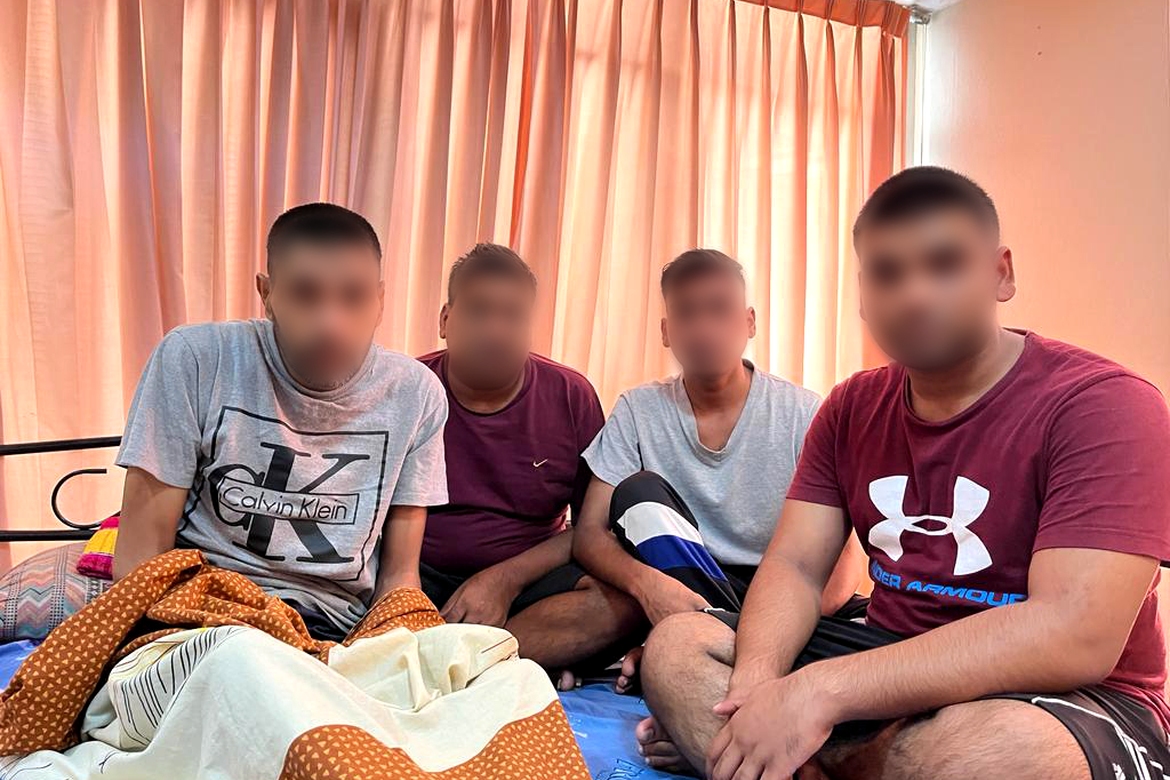
Stephan Masih (left), his brother Francis and nephews Daoud and Hamraz are not in prison, but share 215 square feet. They are refugees because of their Christian faith.
For more than three years, Stephan Masih, a Christian man with bipolar disorder, was imprisoned on false charges of blasphemy in Pakistan.
Accused under one of the country’s most feared laws, he was jailed without conviction and beaten – both by an angry mob and by fellow prisoners.
Today, Masih is no longer behind bars—but he is not free.
Stephan Masih fled for his life to Bangkok, Thailand, together with his brother Francis Masih and Francis’ two sons, 18-year-old Daoud and 22-year-old Hamraz. Since, they have lived as undocumented refugees, with no legal status, no right to work, and limited access to medical care.
“We fled to save our lives,” says Francis Masih.
Exhausted and traumatized
The four men share a single room in Bangkok. Their belongings amount to one bed, one mattress, a refrigerator, a few pots and pans, some tubs of water, and a small supply of food. Until last fall, Hamraz and Daoud slept directly on the tile floor. Eventually, their landlord found a mattress for them to share.
We meet the family in their apartment, in Bangkok, Thailand. Here, they exist under the radar, as paperless refugees. Their exhaustion is visible.
The Masih family entered Thailand on a tourist visa. When the initial 60-day period expired, they were left without any legal status. That lack of documentation means they currently have no rights and live in constant fear of being arrested and deported from Thailand.
Most days, Stephan does not leave his bed. He is weakened by illness, the trauma of incarceration, and strong medications. The only time he leaves the room is for regular doctor’s appointments, at the single hospital in Bangkok that treats undocumented migrants.
He does not dare follow his doctor’s orders for fresh air and social interaction.
“We’re afraid. We often hear about refugees being arrested and sent to internment camps. Stephan often asks if he’s still in prison,” his nephew Hamraz Masih says.
Family still trapped in Pakistan
When Francis fled with his brother and sons, the family did not have enough money for everyone to escape. Francis’ wife, their 21-year-old daughter, and their youngest son, 16, remain in hiding in Pakistan.
“My daughter asks if we will ever meet again. My wife has developed high blood pressure,” Francis says, hiding his tear-filled face in his hands. “We worry about our family every single day.”
Seven years in fear
The family’s nightmare began in early 2019. Francis says their neighbors, who are Muslim, would climb up onto the family’s roof to fly pigeons – often bringing others with them. Francis says, “they made noise and disturbed us. I asked them several times to stop.”
“The neighbor became angry and asked why a Christian dared to complain,” he adds.
The man gathered a violent mob that attacked Stephan, and accused him of insulting the Prophet Muhammad while Stephan was working in the garden. The mob shouted that “the punishment for blasphemy is death” and set the family’s house on fire.
Francis was at work. His sons were at school. Francis’ wife, along with the brothers’ mother and sister, ran for their lives. The police arrested Stephan—and let the mob go free.
He was bleeding from his nose and head. Since the incident, he has had severe hearing loss in one ear.
Stephen looks up, in one of the few moments during our visit he is alert enough to speak about his case. “When the other prisoners found out why I was there, I was beaten,” Stephan says quietly.
For six weeks after the attack, the family did not know where Stephan was being held. Eventually, a Christian organization eventually secured a lawyer, who located him and demanded a medical evaluation.
Years without a verdict
After 12 months, psychiatrists concluded that Stephan suffers from bipolar disorder.
After spending three and a half years behind bars—without a verdict—he was released on bail, which his brother paid. But even after that, Stephan was still in danger.
“Muslim extremists said that even though the judge had released Stephan, their own death sentence still applied,” Francis says. “His lawyer advised us to get Stephan out of the country.”
Surviving, but not making ends meet
In Bangkok, the family survives on minimal support. “We survive on a box of food a church regularly gives us. We receive it once a month, but it only lasts about two weeks,” Hamraz says.
A Christian organization also provides financial assistance equivalent to about $115 per month, far from enough to cover basic needs for the four men.
Hamraz and Daoud occasionally find short-term labor at a restaurant or business willing to hire refugees. The two brothers are teaching their father English, while he looks for work opportunities. Hamraz dreams of becoming a doctor, but admits his future is entirely uncertain.
Calling on fellow Christians to help
Meanwhile, Stephan’s mental health continues to deteriorate. While we interview the family, he is barely cognizant.
“I can’t bear being stuck in this room anymore,” Stephan Masih says.
The family has escaped immediate death but remains unwanted and unprotected.
“I ask all Christians and everyone who cares about human rights to help us,” Francis says.
“We desperately need a safe country to go to, where we can rebuild our lives and where Stephan can receive medical help.”
He pauses, then adds: “The only hope we have may be that you share our story.”
Written by Johannes Morken, first published Febuary 2026.