At 18, he marched for Islamic revolution – now, he supports Iran's underground church
In 1979, Mehrdad Fatehi was 18 years old. He walked the streets of Tehran, the Iranian capital, protesting the shah – and welcoming the islamic revolution.
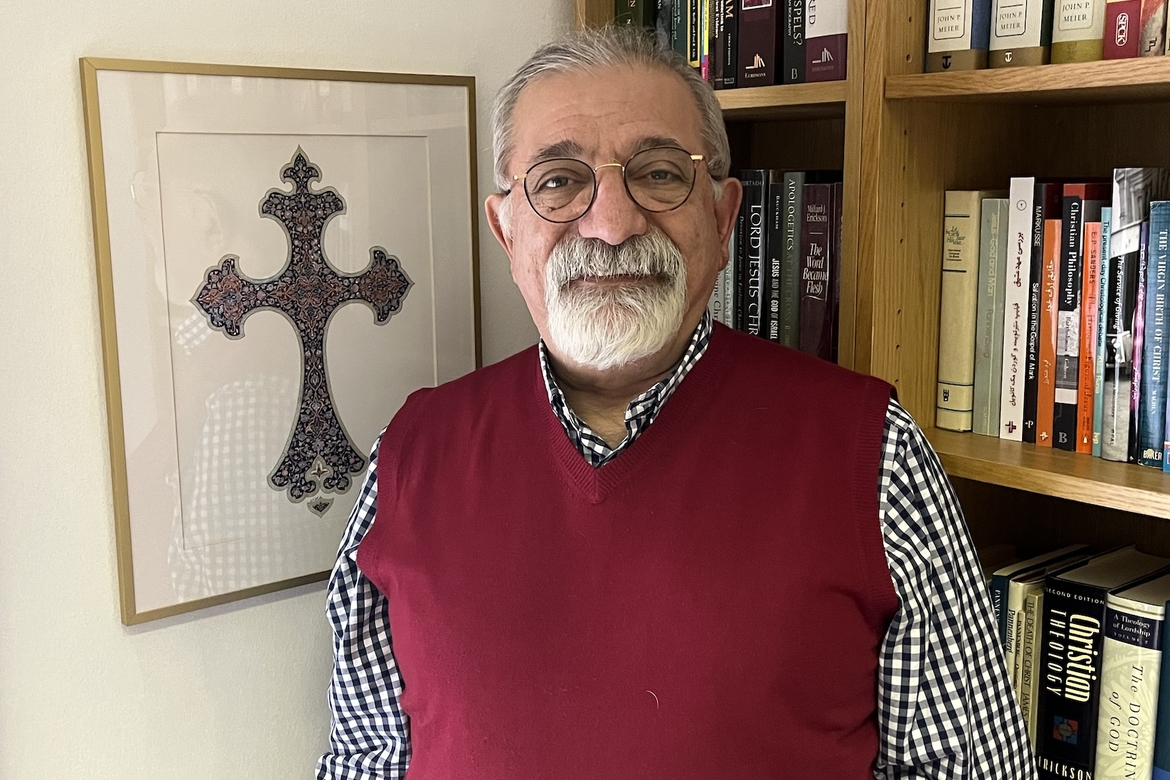
“As a Christian,” he says, “I didn’t cry ‘death to the Shah’, but I did support the revolution. Everyone wanted to be rid the Shah,” says Fatehi, who is now 65.
We meet Fatehi in London, where he directs Pars – a center offering theological education for the underground church in Iran, and Iranian Christians outside Iran.
“It became 47 years of tyranny,” Fatehi says.
Fatehi himself grew up in a Muslim family, and converted to Christianity in his youth. Before 1979, there were few converts. But as the Iranian journalist Fred Petrossian writes, for Christian believers from Muslim backgounds, “the hell called the Islamic Republic began early”. Eight days after the revolution, an Anglican priest who had converted from Islam was brutally murdered in the city of Shiraz. In the first years of the revolution, more church leaders would be killed.
But Christian converts were not alone. The oppression of women began early. Leaders in the Baha’i community were killed, and Jewish leaders attacked. All political opposition was to be stopped, by death penalty when necessary.
Education for leaders in the Iranian church
For the last 47 years, Fatehi has seen what the regime can do. He has witnessed a once-resourceful nation be led to poverty, by a regime that has spent unimaginable resources on rockets, enriching uranium, and supporting militias in neighboring nations.
Personally, Fatehi decided to leave the country and assist Iranian Christians from the outside. Pars has continued to be a beacon: helping students who have been arrested and offering mental health support and trauma recovery to hundreds of people – in addition to its mission to educate the Iranian church.
“War is always evil”
Each time Iranians have protested against the dictatorship, the regime has responded with brutality. In 2009, the green movement was struck down after a manipulated election. In 2019, between 40 and 148 protesters were killed by the government. In 2022, at least 500 people were killed by the government crackdown on the “Woman, Life, Freedom”-protests in 2022. Then came the January 2026 protests: at least 35 000 killed, in two days.
That open brutality became a turning point. Mansour Borji, an Iranian exiled in London, recently told us that “for the first time, Iranians began openly discussing the need for an outside intervention against tyranny.”
But Mehrdad Fatehi is very quick to reject any discussion of a “holy war”, or the other talking points from the American Trump administration. He rejects the idea that President Donald Trump is “God’s man on earth”, and was disturbed when Trump threatened to kill the entire Iranian civilization. Similarly, he rejects the idea of Christian nationalism – much like he rejects Islamic nationalism.
While the Stefanus Alliance not only defends human rights, but also international law, and have a deep concern for the dangerous and global repercussions of the war in Iran, I allow myself to listen to the desperate Iranian plea.
“War is always evil. But in Iran, people will either risk being killed by the regime, or risk dying in war,” said an Iranian Christian I met after a worship service in London.
The Sunday before the war broke out, Fatehi had himself preached the sermon in this Iranian church in London, from a text where God holds responsible those who shed innocent blood. “That is God’s red line,” Fatehi said. He looked directly in the camera for church’s video stream and said God would punish and humble the Iranian regime for the massacres committed in January.
Given the “murderous brutality”, Fatehi is open to seeing the beginnings of the war as a “just war”. He is disappointed that some Western commentators seem to lose sight of the “dangerous and murderous regime”. For that reason, he says, he and they do not come to the same conclusion.
But the Pars director acknowledges a weak link in his own reasoning: the intentions of Trump and Benjamin Netanyahu, the Israeli prime minister. To them, the Iranian people’s freedom is not what is most important.
Hoping for a weakened regime
Some Iranian Christians in exile fear that the remnants of the regime have been strengthened by the war. Still, they hope and pray that the regime has been genuinely weakened by the attacks. Inside Iran, people await the day they can dare to speak up again, without fear of being shot and killed by the revolutionary guard.
The few Christians inside Iran the staff at Pars have been able to contact, with cell phone and internet access shut off, describe a desperate situation. One man Fatehi spoke with says if the regime survives outside he can see no hope, if the regime survives in an agreement with Western nations.
Our Iranian partners in exile are also watching the story of Lebanon unfold, as the Iranian-supported fighters in Hizbollah pulled their own nation into yet another war. Pastor Robert Asserian, a Pentecostal pastor who was imprisoned in Teheran for three weeks before fleeing, says he understands that Israel cannot live with rocket attacks. At the same time, he says he – an Armenian, on visits to Lebanon – has also met Armenian Christians who praise Hizbollah for standing up to immense Israeli destruction.
Turning their backs on Islam
After what they’ve witnessed from the ayatollahs, millions of Iranians have turned their backs on all religion. At the same time, hundreds of thousands have found meaning in the Christian faith. How many they truly are, only God knows.
However the Dutch research group Gamaan published a survey in 2020, where of 50 000 respondents 1.5% self-identified as Christian. If that number holds, there are approximately 1 million Christian converts – believers with a Muslim background (BMBs). In addition, approximately 300 000 people belong to the historic Armenian and Assyrian churches. The historic minorities are allowed to worship freely – provided they use their ethnic languages, and do not share their faith with a Muslim. For converts, their church buildings are off limits. This makes house churches the only real gathering place for converts – places labeled “threats against national security”, by the late ayatollah Khamenei in 2010.
Regardless of the true number of converts, Iran is decidedly one of the world’s nations with the fastest growing church. Fatehi believes the church will grow even more after the ayatollah regime, one day, falls. He does not, however, feel that persecution automatically causes the church to grow.
“Secularism will also grow. But it will be a shock to the Middle East that Iran, which is currently ruled by such a brutal Shiite ideology, has so many people coming to faith in Christ when they are given the opportunity,” Fatehi said.
Written by Johannes Morken and originally published in Norwegian on stefanus.no.